
 Proofreading & Editing

 Academic Editing Services

 Admissions Editing Services

 Business Editing Services
AI Academic Editing: Tips for Refining Your Paper Before Journal Submission
Your manuscript is almost complete. You've finalized your results, refined your argument, and incorporated your coauthors' feedback.
As you review the paper before submission, new questions arise:
"Is this sentence grammatically correct but still awkward?"
"Is my Discussion too wordy?"
"Am I repeating the same expressions?"
"Does this conclusion sound stronger than my results justify?"
At this stage, checking your manuscript involves more than just grammar. You must assess whether your sentences are clear and concise, whether the language suits a scholarly audience, and whether each claim accurately reflects your findings.
AI academic editing helps identify passages that need attention and compare possible revisions. For PhD researchers preparing a journal submission, it offers a practical way to review the language of their completed manuscript.
This guide explains how to use the Wordvice AI Proofreader for your final review and how to decide which suggestions to include in your paper.
Step 1. Finalize Your Research Content Before Refining the Language
Before making detailed sentence-level changes, confirm that the substance of your paper is settled.
Check that your main findings and claims are final, the numbers in your Methods and Results are accurate, and your coauthors' major revisions have been incorporated.
If your interpretation is still changing, particularly in the Discussion, polishing individual sentences may add unnecessary work. You could end up rewriting passages you have already reviewed.
A final language review is most useful when:
- Your results and main claims are established.
- Your sections and paragraphs are ordered correctly.
- You have addressed your coauthors' main comments.
- You do not expect substantial additions or deletions.
- Your remaining concerns involve clarity, conciseness, and wording.
You should verify scientific accuracy throughout the process. However, the review focuses on how clearly and faithfully the language conveys your completed research.
Step 2. Select Academic as Your Document Type
Language suitable for an email or application essay may not be applicable to a journal manuscript.
In Wordvice AI Proofreader, you can select a Document Type to match your text. For a research paper, choose Academic.
This setting provides a starting point for reviewing scholarly documents, including journal manuscripts, dissertations, theses, and abstracts.
Selecting Academic does not ensure all suggested revisions suit your paper. You still need to assess the wording for your discipline's conventions, intended meaning, and target journal's instructions.
Step 3. Choose an Editing Mode That Matches the Passage
Different parts of your manuscript may require varying levels of intervention. Wordvice AI Proofreader offers four modes: Light, Standard, Intensive, and Concise.
| Your Current Concern | Mode to Try | What to Review |
|---|---|---|
| You want an overall check for errors and awkward wording. | Standard | Grammar, word choice, and unclear expressions. |
| A paragraph contains awkward sentence structures or difficult-to-follow phrasing. | Intensive | More substantial revisions to wording and sentence structure. |
| Your abstract or discussion is too lengthy or repetitive. | Concise | Opportunities to remove unnecessary wording while ensuring that the intended meaning is preserved. |
| You want one final check for basic errors before submission. | Light | Grammar, spelling, and punctuation with limited changes to the original structure. |
For example, you may begin with Standard, try Concise on an overlong abstract, and use Intensive on a few difficult discussion paragraphs.
After reviewing those changes, you can use Light for a final pass.
You do not need to run every passage through all four modes. Choose the mode that addresses your specific problem.
How Document Type Can Affect a Suggestion
The same sentence may receive different suggestions depending on the selected Document Type.
In the Light-mode comparison shown below, General retained if, while Academic suggested whether.
Original:
Previous studies show high false positive rates for non-native English writing, yet it is unclear if detectors analyze AI content specifically or broader linguistic features.
Suggested revision with Academic selected:
Previous studies show high false positive rates for non-native English writing, yet it is unclear whether detectors analyze AI content specifically or broader linguistic features.
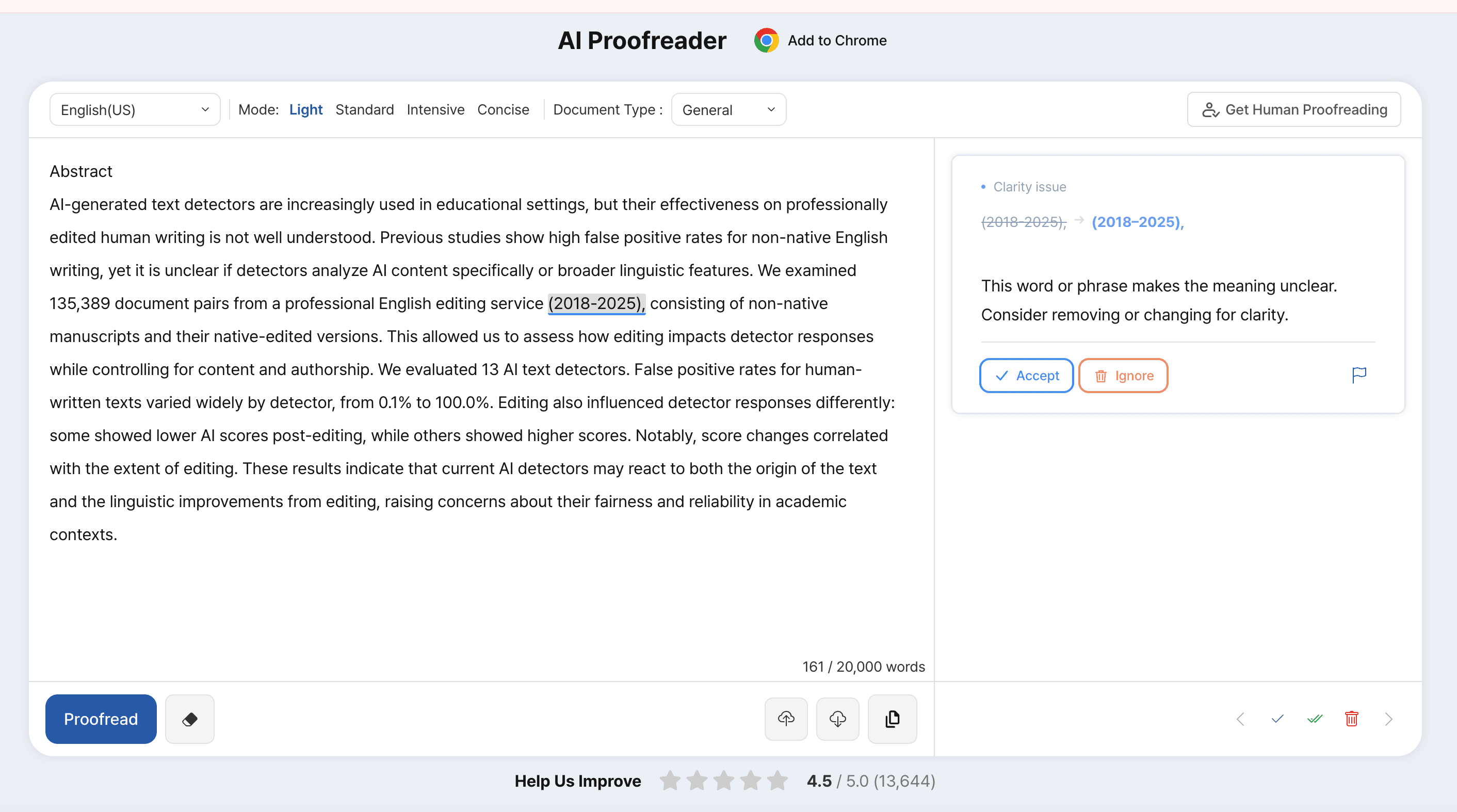
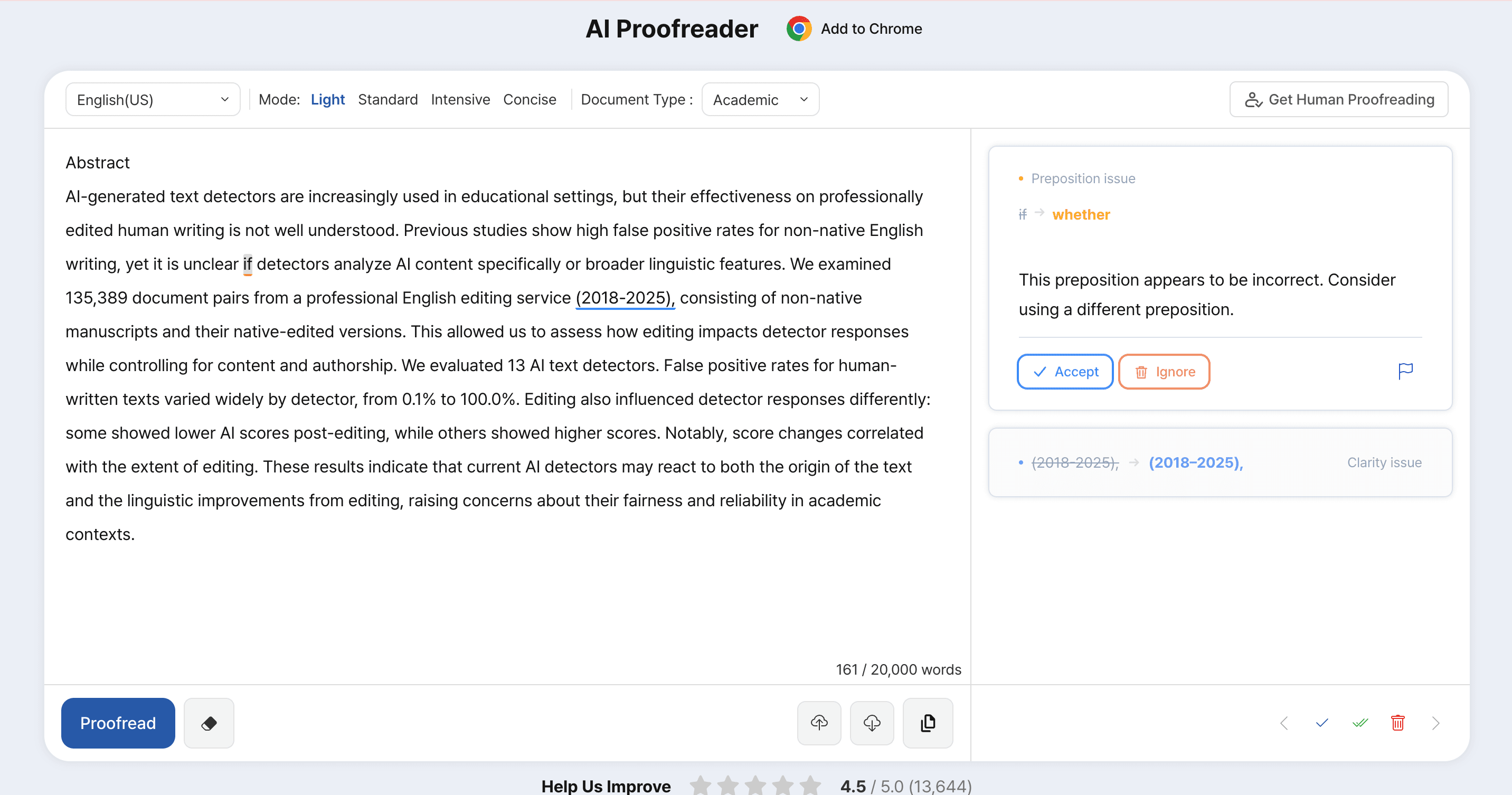
The original use of if is not necessarily a grammatical error. Here, whether makes the alternatives explicit and suits the formal context.
This comparison illustrates the type of wording suggestion you may encounter. Results may vary, and each revision needs contextual evaluation.
Step 4. Review Academic Tone, Clarity, and Conciseness
A sentence can be grammatically correct and still sound too conversational, unnecessarily complicated, or stronger than the evidence supports.
When reviewing academic tone, focus on precision and readability. Replacing familiar words with longer ones does not automatically improve the quality of a manuscript.
The illustrative examples below show how to evaluate possible revisions. They are not presented as verified Wordvice AI outputs.
Remove Unnecessary Wording
Before:
It is important to note that the results of the present study suggest that treatment response may vary between groups.
Possible revision:
The results suggest that treatment response may vary between groups.
The revision removes an unnecessary introduction while retaining suggest and may. Those words help preserve the original level of certainty.
Conciseness should make the finding easier to understand without removing a condition, qualification, or limitation.
Replace Conversational Wording to Enhance Precision
Before:
A lot of previous studies looked at this problem.
Possible revision:
Many previous studies examined this problem.
The revision uses a more suitable register without adding elaborate vocabulary.
Check the verb carefully, too. The terms examined, measured, compared, and evaluated describe different activities. Choose the word that accurately represents what the studies did.
Step 5. Check That Revisions Preserve the Strength of Your Claims
One of the most important parts of AI academic editing is comparing what a sentence claims before and after a revision.
Consider this hypothetical example.
Original:
The results show an association between increased social media use and lower academic performance.
An inappropriate revision to reject:
The results prove that increased social media use causes lower academic performance.
The second sentence changes the scientific claim. An association between two variables does not establish that one causes the other.
A fluent revision is unsuitable if your study design and results cannot support it.
Pay particular attention when a suggestion changes or removes words such as:
- suggest
- indicate
- demonstrate
- prove
- associated with
- affect
- cause
- may
- likely
These expressions can change certainty, causality, or the scope of a statement. They are distinct, and their effect varies with the sentence.
For every substantive revision, ask:
"Does my evidence support exactly what this revised sentence says?"
Step 6. Give the Abstract and Discussion a Separate Review
After reviewing the full manuscript, read the Abstract and Discussion again as individual sections. Each requires particular attention to how findings are summarized and interpreted.
Abstract: Check Conciseness and Consistency
Ask yourself:
- Have I repeated the same point?
- Are the study's purpose and findings clearly distinguishable?
- Does the opening take too long to reach the research question?
- Do the key terms match those used in the main text?
- Does the conclusion stay within the evidence presented?
If the abstract is too long, try Concise mode and compare the suggestions. Retain essential details for interpreting the findings, even if omitting them would reduce word count.
Discussion: Check Interpretation and Claim Strength
Ask yourself:
- Have I distinguished findings from interpretations?
- Are comparisons with previous research easy to follow?
- Have I preserved the study's limitations?
- Am I generalizing beyond the population or conditions studied?
- Are the implications and conclusions clear?
If you use Intensive mode, compare the revised paragraph with the original carefully. Changes to sentence structure can affect emphasis, logical relationships, and the strength of an interpretation.
Review Suggestions Individually Before Accepting Them
Wordvice AI Proofreader provides suggestions and explanations for language issues, including grammatical errors and awkward or unclear expressions.
For a journal manuscript, review each suggestion individually. A change that reads smoothly may still be incorrect for your research.
| What to Check | What to Look For |
|---|---|
| Technical terminology | Has a precise disciplinary term been replaced with a broader or different expression? |
| Numbers and units | Are values, units, comparison groups, and directions of change preserved? |
| Causal language | Has a relationship been rewritten as a cause-and-effect claim? |
| Qualifying language | Have words such as "may," "might," or "potentially" disappeared? |
| Key concepts | Is the same concept named consistently across the manuscript? |
Repeated terminology is not always a problem. Consistent terminology for the same variable or concept improves clarity. Avoid introducing synonyms simply to make the wording more varied.
AI can highlight important passages. Your knowledge of the research determines the appropriateness of a suggestion.
Your Final Checklist Before Submission
Once you have reviewed and incorporated the necessary changes, check the manuscript one final time:
- Are any grammar, spelling, or punctuation errors still present?
- Does the academic tone suit your discipline and intended readers?
- Have you removed unnecessary repetition and wordiness?
- Are technical terms and variable names consistent?
- Does the Abstract use the same key terminology as the main text?
- Have all accepted revisions preserved the research meaning?
- Does the strength of each claim match the evidence?
- Have you used American or British English consistently?
- Have you checked the target journal's language and manuscript instructions?
Completing this language review is essential for your submission preparation. Use the target journal's specific requirements to check the remaining materials.
Make AI Academic Editing Part of Your Final Author Review
For a PhD researcher approaching submission, the goal is to enhance the clarity and precision of a completed manuscript while maintaining the integrity of the research.
Start with the Academic Document Type, choose an appropriate editing mode for the passage, and compare suggestions against your original wording. Focus on the Abstract, Discussion, technical terminology, and claim strength.
Using Wordvice AI Proofreader this way can enhance your final language review efficiency. You remain responsible for deciding which changes communicate your findings accurately.
Open your manuscript in Wordvice AI Proofreader, select Academic, and begin with a passage for review.